


Looking for a way to level up your food business? Well, the only way in 2026 is to consider investing in technology that not only captivates users but also keeps them coming back for more.
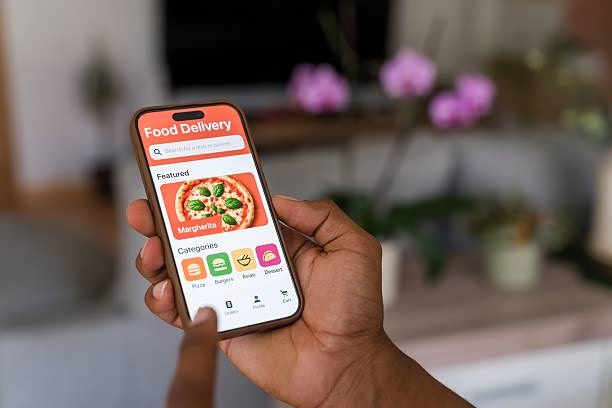
The online food industry has dominated the market since the pandemic, making now the perfect time to invest in it. Statistics show that the online food delivery market is projected to reach $505.5 billion by 2030, which is quite impressive. This is precisely why you should consider investing in it now.
Picture this: You’re hungry, it’s late, and within minutes, your favorite meal arrives at your doorstep. That seamless experience? It’s powered by sophisticated technology that costs millions to develop. The food delivery app development cost isn’t just a random number pulled from thin air.
It’s a carefully calculated investment that determines whether your app becomes the next Uber Eats or fades into obscurity. Understanding how these costs are calculated can mean the difference between building a profitable platform and burning through your budget before launch.
The Anatomy of Food Delivery App Development Costs: A Visual Breakdown
| Component | Percentage of Total Cost | Estimated Range |
| Frontend Development | 20-25% | $15,000 – $30,000 |
| Backend Infrastructure | 25-30% | $15,000 – $30,000 |
| UI/UX Design | 10-15% | $8,000 – $18,000 |
| Third-Party Integrations | 15-20% | $12,000 – $25,000 |
| Testing & QA | 10-12% | $8,000 – $15,000 |
| Project Management | 8-10% | $6,000 – $12,000 |
| Maintenance (Annual) | 20% of development | $10,000 – $25,000 |
The delivery app development cost varies dramatically based on complexity, features, and the geographic location of your development team. Let’s unpack each element.
Core Components That Define Your Budget
App Architecture: The Foundation of Everything
Single Platform vs. Cross-Platform Development
Your first major decision impacts everything else. Native iOS and Android apps offer superior performance but require separate codebases. Cross-platform solutions like React Native or Flutter reduce costs by 30-40% but may sacrifice some native functionality.
- Native Development: $80,000 – $150,000
- Cross-Platform Development: $50,000 – $100,000
- Hybrid Approach: $60,000 – $120,000
The Three-App Ecosystem
Unlike simple applications, food delivery platforms require three interconnected apps:
- Customer App: The user-facing interface
- Restaurant/Vendor App: For order management
- Delivery Driver App: For logistics and navigation
Each app requires its own development resources, testing protocols, and maintenance schedules.
Feature Complexity: From Basic to Enterprise-Grade
Tier 1: Essential Features (MVP Approach)
If you’re validating your concept, starting with an MVP Design is crucial. This stripped-down version includes:
- User registration and profiles
- Restaurant listings with menus
- Basic search functionality
- Cart and checkout system
- Order tracking
- Payment integration
- Push notifications
Cost Range: $40,000 – $70,000
Tier 2: Competitive Features
To compete with established players, you’ll need:
- Advanced search filters
- Real-time GPS tracking
- In-app chat support
- Multiple payment gateways
- Rating and review systems
- Scheduled deliveries
- Promo code engine
- Analytics dashboard
Cost Range: $70,000 – $120,000
Tier 3: Premium Features
For market leadership, consider:
- Artificial Intelligence-powered recommendations
- Predictive ordering based on user behavior
- AR menu visualization
- Voice ordering integration
- Subscription models
- Loyalty programs with gamification
- Multi-language support
- Dark mode and accessibility features
Cost Range: $120,000 – $250,000+
Design Investment: Why UI/UX Can’t Be an Afterthought
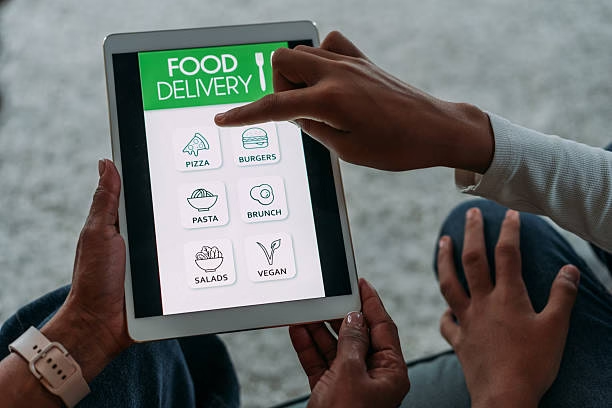
Poor design is the silent killer of food delivery apps. Users make split-second decisions, and if your interface confuses them, they’ll delete your app instantly. Investing in professional UI/UX design isn’t optional; it’s survival.
The Design Process Breakdown
Phase 1: Research & Strategy (2-3 weeks)
- User persona development
- Competitor analysis
- User journey mapping
- Cost: $3,000 – $8,000
Phase 2: Wireframing & Prototyping (3-4 weeks)
- Low-fidelity wireframes
- Interactive prototypes
- User testing iterations
- Cost: $5,000 – $12,000
Phase 3: Visual Design (4-6 weeks)
- Brand identity integration
- High-fidelity mockups
- Design system creation
- Micro-interactions
- Cost: $8,000 – $20,000
Understanding Why Design Thinking Is a Game-Changer for Enterprise App Development becomes critical when you’re competing against giants like Uber Eats and DoorDash.
Technology Stack Decisions: The Price-Performance Matrix
Backend Technologies
Option 1: Serverless Architecture (AWS Lambda, Firebase)
- Pros: Scalable, pay-per-use, faster deployment
- Cons: Vendor lock-in, cold start issues
- Cost Impact: Reduces initial development by 20-30%
Option 2: Traditional Server Setup (Node.js, Python Django)
- Pros: Full control, better for complex logic
- Cons: Higher maintenance, infrastructure costs
- Cost Impact: Standard pricing baseline
Option 3: Microservices Architecture
- Pros: Scalable, maintainable, team-friendly
- Cons: Complex, requires DevOps expertise
- Cost Impact: Increases development cost by 30-40%
Database Considerations
Your choice affects both performance and cost:
- PostgreSQL/MySQL: Free, reliable, complex queries
- MongoDB: Flexible schemas, horizontal scaling
- Redis: Caching layer, real-time features
- Amazon DynamoDB: Serverless, auto-scaling
Budget allocation: $5,000 – $15,000 for database architecture and optimization.
Integration Costs: The Hidden Budget Eaters
Payment Gateway Integration
Every transaction needs to be secure and seamless:
- Stripe: $2,000 – $5,000 integration
- PayPal: $2,000 – $4,000 integration
- Local payment methods: $1,500 – $3,000 each
- Digital wallets: $2,000 – $5,000
Mapping and Navigation APIs
Real-time tracking is non-negotiable:
- Google Maps Platform: $3,000 – $8,000 integration + usage fees
- Mapbox: $2,500 – $6,000 integration + usage fees
- Route optimization algorithms: $5,000 – $12,000
SMS and Push Notifications
Communication infrastructure costs:
- Twilio for SMS: $2,000 – $4,000 setup
- Firebase Cloud Messaging: $1,500 – $3,000
- OneSignal: $1,000 – $2,500
Third-Party Services
- Customer support (Zendesk, Intercom): $2,000 – $5,000
- Analytics (Mixpanel, Amplitude): $2,000 – $4,000
- Crash reporting (Sentry): $1,000 – $2,000
Development Team Structure: What You’re Actually Paying For
The Optimal Team Composition for a 6-Month Project
├── Project Manager (Full-time) ────────────── $25,000 – $50,000
├── Business Analyst (Part-time) ──────────── $10,000 – $20,000
├── UI/UX Designer (Full-time) ────────────── $20,000 – $40,000
├── iOS Developer (Full-time) ─────────────── $30,000 – $60,000
├── Android Developer (Full-time) ─────────── $30,000 – $60,000
├── Backend Developer (2x Full-time) ──────── $50,000 – $100,000
├── QA Engineer (Full-time) ───────────────── $20,000 – $35,000
├── DevOps Engineer (Part-time) ───────────── $15,000 – $30,000
├── Total Team Cost ───────────────────────── $200,000 – $395,000
Development Timeline: Time is Money
Phase-Wise Breakdown
Discovery & Planning (3-4 weeks)
- Market research
- Technical documentation
- Feature prioritization
- Cost: 5-8% of total budget
Design Phase (6-8 weeks)
- Complete UI/UX design
- Design system creation
- Prototype development
- Cost: 10-15% of total budget
Development Sprint (16-24 weeks)
- Frontend development
- Backend infrastructure
- API development
- Third-party integrations
- Cost: 60-70% of the total budget
Testing & QA (4-6 weeks)
- Functional testing
- Performance testing
- Security audits
- User acceptance testing
- Cost: 10-12% of the total budget
Deployment & Launch (2-3 weeks)
- App store submission
- Server configuration
- Monitoring setup
- Cost: 3-5% of total budget
Liquid Technologies: Engineering Tomorrow’s Food Delivery Giants
While most agencies promise you an app, Liquid Technologies delivers a competitive advantage. We don’t just calculate costs; we optimize them.
Our Strategic Approach to Cost Management
1. Intelligent Feature Prioritization
Our data-driven approach identifies which features actually drive user retention versus which ones drain your budget. We build what matters first.
2. Proprietary Development Framework
Our pre-built modules for common food delivery functionalities reduce mobile app development time by 35%. These battle-tested components handle everything from order matching algorithms to driver allocation systems, meaning you pay for customization, not reinventing the wheel.
3. Flexible Engagement Models
- Fixed-Price Projects: Complete price certainty for well-defined scopes
- Time & Material: Flexibility for evolving requirements
- Dedicated Team: Your extended development arm
- Revenue Sharing: We succeed when you succeed
4. AI-Powered Cost Optimization
Understanding How Much Does an AI-Powered App Development Cost is just the beginning. Our proprietary AI tools analyze your user behavior predictions and market dynamics to recommend the most cost-effective feature roadmap.
Hidden Costs That Catch Founders Off-Guard
Post-Launch Operational Expenses
Infrastructure & Hosting
- Startup phase: $500 – $2,000/month
- Growth phase: $2,000 – $10,000/month
- Scale phase: $10,000 – $50,000+/month
API Usage Fees
The more successful you become, the more you pay:
- Google Maps API: $0.005 – $0.02 per request
- SMS notifications: $0.01 – $0.05 per message
- Payment processing: 2.9% + $0.30 per transaction
Customer Support Infrastructure
- Support software licenses: $500 – $2,000/month
- Support staff (as you scale): $3,000 – $15,000/month
Marketing & User Acquisition
Technology is only half the battle:
- App Store Optimization: $2,000 – $5,000 initially
- Digital marketing budget: $10,000 – $100,000+/month
- Referral program costs: 3-10% of transaction value
- Restaurant onboarding incentives: $50 – $500 per restaurant
Legal & Compliance
- Terms of service and privacy policy: $2,000 – $5,000
- GDPR/CCPA compliance: $5,000 – $15,000
- Insurance and liability coverage: $5,000 – $20,000/year
- Trademark registration: $1,000 – $3,000
Ongoing Maintenance & Updates
Budget 15-20% of the initial development cost annually:
- Bug fixes and performance optimization
- OS updates (iOS and Android release new versions annually)
- Security patches
- Server maintenance
- Database optimization
Cost Optimization Strategies: Getting More for Less
The MVP Philosophy
Launch with 60% of planned features. Real user feedback is worth more than assumed requirements. You’ll save $30,000 – $80,000 on features users don’t actually want.
White-Label Solutions vs. Custom Development
White-Label Platforms:
- Initial cost: $10,000 – $30,000
- Monthly fees: $500 – $2,000
- Pros: Fast launch, lower risk
- Cons: Limited differentiation, ongoing costs
Custom Development:
- Initial cost: $60,000 – $250,000
- Ownership: Complete
- Pros: Full control, unique features
- Cons: Higher upfront investment, longer timeline
Outsourcing vs. In-House Team
In-House Development:
- Annual cost per developer: $80,000 – $150,000
- Total control and IP ownership
- Best for: Well-funded startups with long-term vision
Outsourcing:
- Project cost: $40,000 – $200,000
- Access to diverse expertise
- Best for: Budget-conscious startups testing market fit
Progressive Web Apps (PWAs)
A PWA can reduce initial costs by 40-50%:
- Single codebase for all platforms
- No app store approval process
- Instant updates
- Trade-off: Limited native features, less discoverability
Open-Source Technology Stack
Leverage free, proven technologies:
- Backend: Node.js, Python, Ruby on Rails
- Database: PostgreSQL, MongoDB
- Real-time: Socket.io, WebSockets
- Savings: $10,000 – $30,000 vs. proprietary solutions
Security Investment: The Non-Negotiable Expense
Data breaches cost food delivery companies an average of $4.24 million. Security isn’t optional.
Essential Security Measures:
- SSL certificates and HTTPS: $500 – $1,500
- Data encryption (at rest and in transit): $3,000 – $8,000
- PCI DSS compliance: $5,000 – $15,000
- Penetration testing: $5,000 – $20,000
- OWASP security guidelines implementation: $3,000 – $10,000
- Regular security audits: $2,000 – $8,000 annually
Security Budget Allocation: 8-12% of total development cost
Scalability Planning: Building for Growth
Your app might start with 1,000 users, but it needs to handle 100,000 within a year.
Infrastructure Scalability
Auto-Scaling Cloud Architecture
- Initial setup: $5,000 – $15,000
- Ensures automatic resource adjustment
- Prevents downtime during peak hours
Load Balancing
- Implementation: $3,000 – $8,000
- Distributes traffic across servers
- Critical for reliability
Database Optimization
- Query optimization: $2,000 – $5,000
- Caching layers: $3,000 – $8,000
- Reduces response times by 40-60%
CDN Integration
- Setup: $2,000 – $5,000
- Monthly costs: $100 – $2,000
- Improves global performance
Code Scalability
Invest in clean, maintainable code:
- Comprehensive documentation: $3,000 – $8,000
- Modular architecture: Built into development
- Automated testing suite: $5,000 – $15,000
Making the Build vs. Buy Decision
When to Build Custom
✓ You have unique market positioning
✓ Budget exceeds $80,000
✓ Long-term competitive advantage is a priority
✓ Specific regulatory requirements
✓ Integration with existing systems needed
When to Use White-Label Solutions
✓ Budget under $50,000
✓ Need to launch within 2-3 months
✓ Testing market viability
✓ Standard features are sufficient
✓ Limited technical team
Conclusion
Understanding food delivery app development cost isn’t about finding the cheapest option; it’s about maximizing value at every decision point. From architecture choices to team composition, every variable impacts your bottom line and competitive position. The apps that succeed aren’t necessarily those with the biggest budgets, but those with the smartest investment strategies.
Whether you’re building the next Uber Eats competitor or creating a hyperlocal delivery solution, partnering with experts who understand cost optimization without compromising quality is crucial. Liquid Technologies has helped dozens of entrepreneurs transform their food delivery visions into profitable realities, and we’re ready to do the same for you.
Ready to turn your food delivery app idea into reality without breaking the bank? Contact Liquid Technologies today for a free cost analysis and strategic roadmap. Let’s build something remarkable together.


